01 / worldGenerate hazards before guidance
Deterministic distance-based functions place pothole fields and compute the line around nearby hazards.
TypeScript · pure track functionsRead the road. Find the line. Hold your nerve.

A visual target for the world: a working taxi, market density, warm dust, and a readable route through the street. This is concept art; a captured browser prototype appears below.
Chaos Riders brings the markets, taxis, weather, and roads of Cameroon into a driving world. My work connects creative direction and product engineering: a launch experience that establishes the world, and a playable browser prototype that puts its central idea under your thumb. The larger game remains in development.
The consequential problem
A market street asks different things of a driver than a clean circuit. The road is uneven, openings narrow, and the best route changes as hazards approach. Those conditions offered the core interaction: look ahead, choose a line, and keep the machine settled.
The experience also had to make sense in a browser and on a phone. A large imagined world could establish ambition, but a short playable run had to explain what the player would actually do.
What I saw
The racing line becomes useful when it responds to the same potholes that can unsettle the car. In the prototype, hazards are generated first, then the line bends around them. Its purpose is legible in motion: it gives the player a path to read, a reason to steer, and a reference for judging the quality of a run.
The decision that changed the system
The browser demo begins with a twenty-second clock. Steering selects the route; braking creates room to react; a timed steady action helps control the machine through a hazard field. Clean driving earns flow feedback and a speed boost. Camera response, road motion, and the HUD make the consequences visible.
That compact loop gave the project a concrete center while the regional world, vehicles, and broader game continued to develop.
The line reveals a route through the approaching pothole field.
Steer toward the route and brake when the next correction needs more room.
Time the steady action as the field challenges the car's stability.
Clean sectors trigger flow; impacts and line quality remain visible in the run feedback.
System anatomy / rationale / surfaces
The launch prototype has its own focused runtime. It pairs deterministic track functions with a Three.js scene and a React interface, while keeping the larger game's engine exploration separate.
The visible path and the collision system could describe different versions of the road.
Generate deterministic pothole fields, then use smooth repulsion and road bounds to shape the line around them.
Rendering and collision can query the same track functions at any distance. The route has a mechanical basis.
Deterministic distance-based functions place pothole fields and compute the line around nearby hazards.
TypeScript · pure track functionsSteering, braking, timed stability, collision response, and flow operate on the current run state.
Touch · keyboard · frame loopThe rendered road, hazard positions, vehicle, camera, and HUD express the same driving state.
Three.js · React Three FiberThe launch page introduces the world, then loads the playable demo at its explicit play interaction.
React lazy · Suspense · ViteWhat the player sees refers to the same situation the collision loop evaluates.
A small input vocabulary supports anticipation and increasingly deliberate control.
Visitors can understand the setting before committing to the driving interaction.
The system becomes tangible through the places people encounter and use it.
Regional imagery connects markets, highlands, rain, and coast to distinct driving conditions.
A bounded browser scene puts line reading, steering, braking, and stability under direct control.
The clock, speed, line quality, impacts, and flow make performance inspectable during and after a run.
The launch experience introduces the machines and their personalities; model development continues alongside the prototype.
Three.js · React Three Fiber · TypeScript
React · Framer Motion · touch + keyboard
Vite · lazy-loaded demo · WebP imagery
Select a tool to see the role it plays in this system.
Road geometry, vehicles, lighting, and hazards share a real-time scene that responds to the player's driving.
Authentic proof
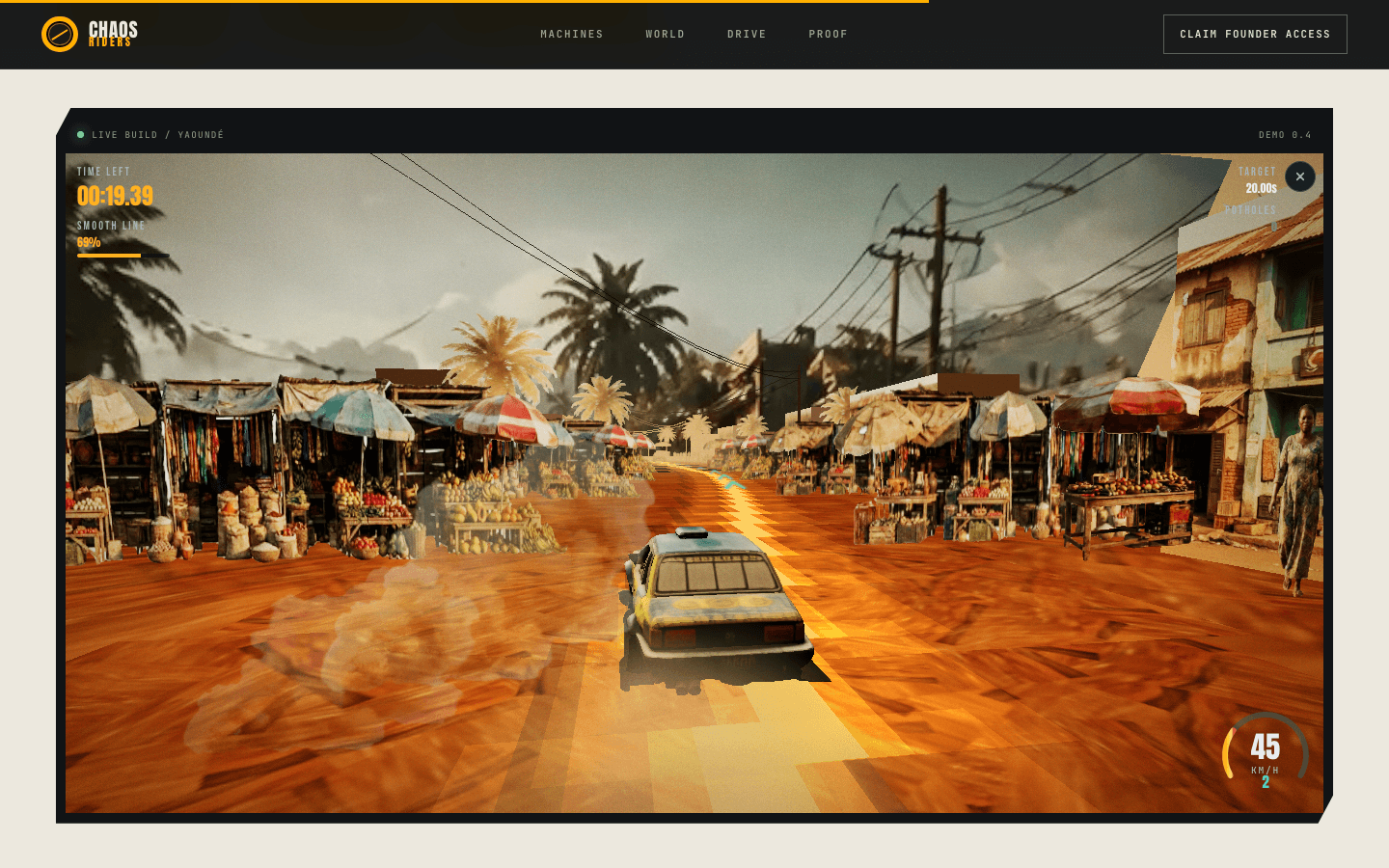
An existing development capture of the playable scene. The road, taxi, racing line, countdown, speed, and line-quality readout are rendered together. This documents the prototype rather than a released full game.
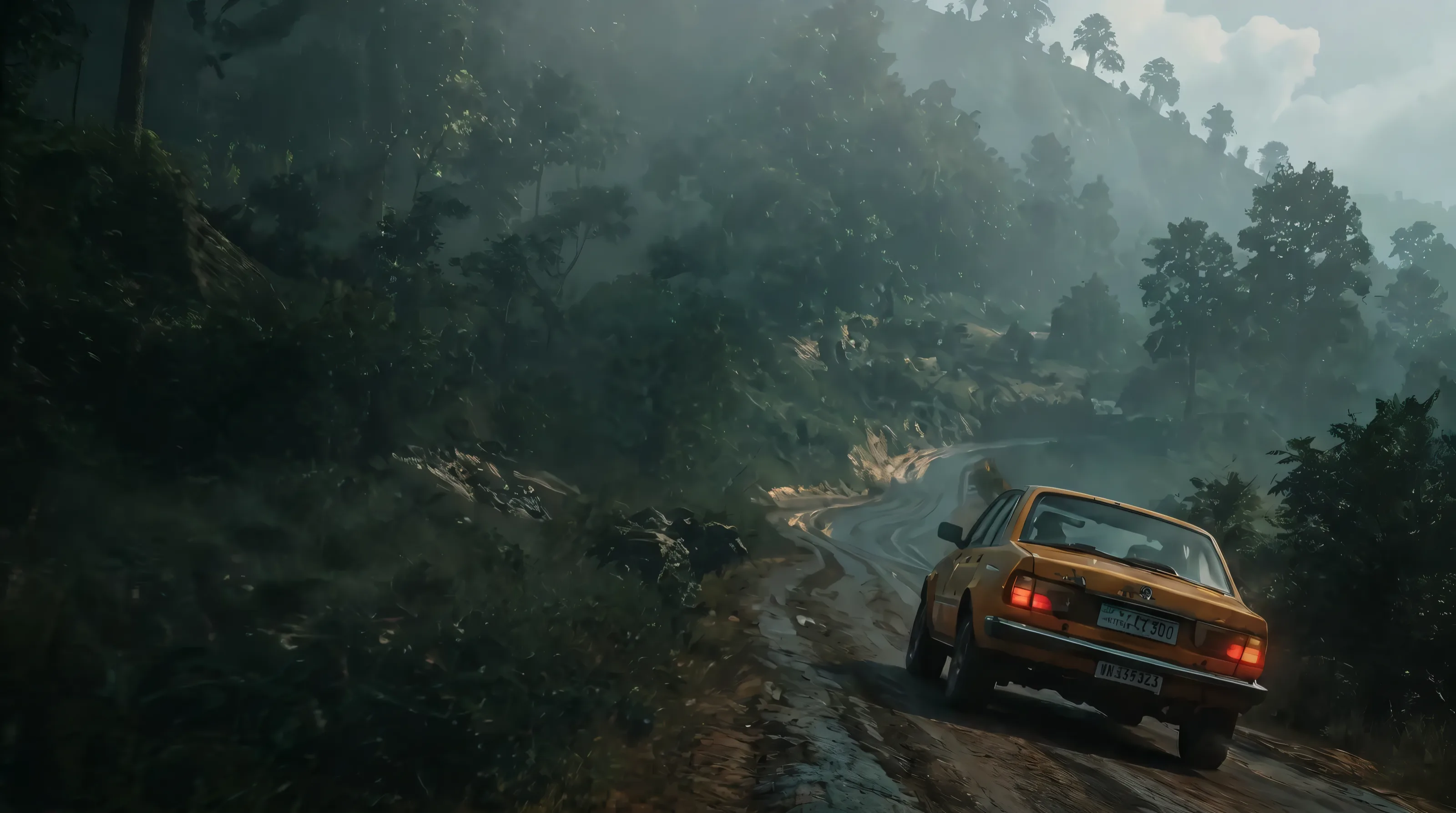
The Bamenda world concept shifts the driving proposition toward highland climbs and control. Regional artwork establishes the intended range; it does not imply that every location is already playable.
What changed in my operating model
The strongest connection between the art and the prototype is the demand the road makes on the player. A turn, a patch of broken ground, and the decision to brake can carry as much identity as a large establishing image. The work continues at that boundary: bringing the visual direction closer to the playable response without losing clarity.
The current evidence is a launch experience, a playable browser prototype, and an evolving game and asset pipeline. The broader game and its regional modes remain in development.