

Can data be trusted before it starts moving?
In regulated finance, data quality and lineage were part of the system. You didn't get to clean up after the pipeline.
Spark · Scala · Snowflake · near-real-time ETLDrag to turn · tap a strand
Cameroonian roots, bioengineering, music, and shared making meet in one practice. None needs to disappear into the others.
Houston builder, Cameroonian roots. What I keep coming back to is amplification. Understand a system well enough that a person, a team, or a generation can move with more agency.
Explore my skills and tools
One thread, four scales
Everything I build makes something survive a handoff. I learned each version of that at a different scale.
The same words carry different weight depending on who is listening and what they have lived. Check the structure before you trust the surface.
Bioengineering, then healthcare systems under HIPAA. Make the risk visible, keep the rollout reversible, attach the evidence. The boundary is where the consequence lives.
A community built by making things together. Everyone kept their own strength and the thing still held. Figma platformed it.
Memory, authority, execution, and proof for agent work. The thread, shipped as infrastructure.
The root system
My Cameroonian roots were my first lesson in translation. The same thing can mean something different depending on context and history. I learned early to look at the structure before believing the surface.
Bioengineering at Rice gave that instinct rigor. With DermaShift, our team built a low-cost way to detect pressure-ulcer risk and won a national undergraduate design competition. A human need, clinicians, sensors, product design, proof. I still work that way.
Music and dance sit in the background. Timing, tension, release. A composition can be technically correct and still feel unfinished.
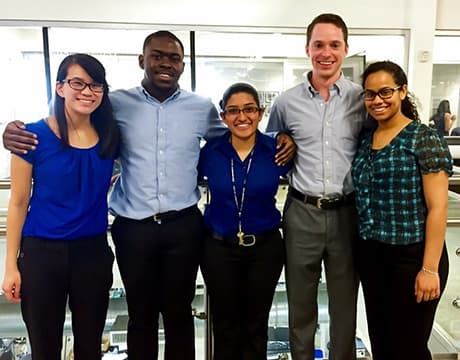
Pressure ulcers aren't a dashboard problem. We had to understand the clinical need, build a portable device, make the economics work, and explain the evidence plainly. That's still how I want engineering to meet the world.
The practice
A hard problem is useful once it shows you the mechanism underneath. I like working with people where disagreement sharpens the model and evidence settles the next move.
A problem can look solved while the person living with it still pays for it.
Start with the person. Then bring whatever disciplines the fix actually needs.
Bioengineering stuck as a product instinct. Understand the system, build the mechanism, prove it worked.
The questions got harder
One practice that kept growing. Not a list of unrelated jobs.
In regulated finance, data quality and lineage were part of the system. You didn't get to clean up after the pipeline.
Spark · Scala · Snowflake · near-real-time ETLI led backend work across auth, calibration, AWS, and internal workflows. Ownership stopped ending at the code.
API architecture · hardware calibration · AWS · operationsHIPAA production taught me to bring privacy in early, make failure visible, keep rollouts reversible, and treat operator trust as engineering quality.
Django · Celery · PostgreSQL · DatadogResearch that turned operating-room capacity into a picture people could actually use.
React · D3.js · scientific and operational visualizationOrgX pulls all of it together. Shared context, agents working in the clients you already use, judgment where it matters, and proof that improves the next decision.
Founder · product · architecture · distributionInspect the systemCollaboration is a creative technology
It started as an empty Clubhouse room. It grew into a global BIPOC design community where people made things together in real time. At Config 2021 we shared how it worked.
Watch the Config talk Connection → community → culture
Production engineering, independent products, research, and creative practice. Explore a discipline, then a tool to see how I use it.
14 highlights · 59 tools to explore
Compose stateful interfaces around the work: learning progress, clinical workflows, and evidence-led decisions.
See it in the workOpen to founder collaborations and senior or staff roles where systems depth, product judgment, and AI-native execution all matter at once.